The British Orchestration of Persia’s Renaming to Iran: Concealing Confiscation of Non-Persian Oil and Gas Lands
Prelogue
In 1935, the British Empire, working through its installed ruler Reza Shah Pahlavi, engineered the official international change of the country’s name from Persia to Iran. This was not a neutral act of cultural accuracy or Iranian self-assertion. It was a deliberate linguistic and legal maneuver to conceal and legitimize the systematic confiscation of oil and gas resources from non-Persian ethnic territories — particularly the Arab lands of Khuzestan, Kurdish regions, Balochistan, and Turkic Azerbaijan — under the umbrella term “Iranian oil.” By erasing the specific identity of “Persia,” the British transformed resource theft from minority provinces into a seemingly unified “national” asset, protecting their financial architecture centered on the Anglo-Persian Oil Company (later Anglo-Iranian).
History and Timeline
1908 Oil Discovery: The first major oil strike occurred at Masjed Soleyman in Khuzestan province (southwestern Persia). This region was (and remains) majority Arab (Ahwazi Arabs), not Persian. Early reports from the Anglo-Persian Oil Company (APOC) and British consular documents describe the area as “Arabistan” or “Arab territory under Persian suzerainty.” British political resident reports from Bushire explicitly distinguished between the Persian plateau and the Arab lowlands.
1914–1932 British Control: The British government acquired 51% of APOC in 1914. The D’Arcy Concession (1901) and subsequent agreements gave Britain exclusive rights over vast territories, many outside the historic Persian heartland of Fars and Isfahan. Khuzestan produced the overwhelming majority of oil. By the 1920s, British documents show concern about Arab unrest and potential separatist claims over the oil fields.
1925 Reza Shah Coup: Reza Khan (later Reza Shah) was installed in a British-backed coup in 1921 and consolidated power in 1925. While he later showed some independence, his early rule was heavily influenced by British interests. British Foreign Office files (FO 371 series) reveal coordination with Reza Shah on centralization policies that suppressed Arab, Kurdish, and Baloch autonomy.
The 1935 Name Change: On March 21, 1935 (Nowruz), the Iranian government formally requested all foreign governments and media cease using “Persia” and use “Iran” exclusively. The request was sent via diplomatic notes to Britain, the United States, Germany, and others. The British Foreign Office immediately complied and instructed media and companies to follow suit. Critically, in the same year, the Anglo-Persian Oil Company was renamed the Anglo-Iranian Oil Company (AIOC).
Oil Geography:
Khuzestan (Arabistan): Contains ~80-85% of Iran’s proven oil reserves at the time. Major fields: Masjed Soleyman, Haft Kel, Aghajari, Ahvaz. Largely Arab population with distinct language and culture.
Kurdistan: Significant oil and gas potential in Kermanshah and Ilam provinces.
Balochistan (Sistan and Baluchestan): Major gas reserves (South Pars is partly connected, but onshore fields and potential in the east).
Azerbaijan: Turkic-speaking region with oil infrastructure and later discoveries.
Why “Iran” Does Not Mean Nation-State or Country
The renaming was far more than cosmetic. It was the crowning act in the creation of a fake “nation-state” structure imposed from above by European colonialism to serve oil company interests. As many analysts of Middle Eastern history have observed, the reason Middle Eastern countries have failed to achieve genuine freedom and prosperity for over 100 years is that they have mistaken democracy for simple majority rule. True democracy requires a people who already share common interests, identity, geography, language, and culture, and who exercise sovereign decision-making over their own affairs. It does not mean forcibly gluing disparate peoples into one artificial geographic unit so that one group is deliberately reduced to a numerical minority, allowing a rootless majority to decide the fate of peoples who share no common religion, language, resources, or destiny.
The classical European nation-state emerged precisely to avoid this problem. After the catastrophic Thirty Years’ War (1618–1648), the nation-state model recognized groups of people who saw themselves as one identity — similar in form and shared interests — and granted them collective rights to prevent endless religious and ethnic conflict. In the Middle East, however, the nation-state was imposed top-down by colonial powers based on arbitrary border demarcations drawn to serve oil company needs, not through any organic bottom-up process by the peoples themselves.
In this context, the entity called “Iran” is not a genuine nation-state or country in the classical sense. It functions as a branch or subsidiary of the European (specifically British) oil company. The artificial borders were designed to lock non-Persian resource-rich regions — Arab Khuzestan, Kurdish areas, Balochistan — into a single administrative unit where the Persian ethnic core (backed by British power) could act as the managing majority. This structure deliberately turns the peoples living atop the underground resources into numerical minorities within their own ancestral lands.
The Viceroy System and the “State of Iran” as British Estate
After Mohammad Mossadegh’s nationalization revolt in 1951, the British oil operation underwent a superficial rebranding. The Anglo-Iranian Oil Company was restructured into the Consortium, with the public appearance of reduced British control. In reality, it was agreed that 14% of extracted oil would go to the representative of the British Crown — the “viceroy” or Shah. The entire territory was reframed as the “State of Iran” (a corporate-style property designation), functioning as a managed estate.
Three successive viceroys were appointed to manage this British oil estate on behalf of the Crown:
Reza Khan Pahlavi
Mohammad Reza Pahlavi
The Shia clerical leadership (referred to by some as the “Shia Pope” structure under Khomeini and his successors)
Each acted as the local administrator and enforcer of the underlying British financial architecture. The 1935 name change from Persia to Iran was essential to this legal fiction: it transformed the entity from a historically Persian-centered realm into a neutral corporate holding (“Iran”) where resource extraction from non-Persian lands could be presented as legitimate “national” revenue.
The Bam Earthquake and Prince Charles’ Visit
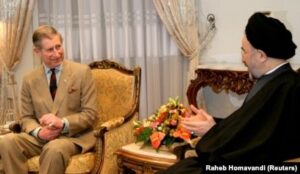
A striking illustration of this ongoing arrangement is the 2003 Bam earthquake. Many informed observers have long noted that Prince Charles’ sole visit to Iran — where he met with both Khatami and Khamenei — was not primarily a humanitarian gesture. It coincided with the quiet renewal and adjustment of the Consortium agreements and BP’s operational rights. The visit to the “properties” (the earthquake zone being in a strategically sensitive area) served as cover for high-level renegotiation of the underlying British-linked oil and financial arrangements that continue to govern the estate.
Conclusion
The 1935 renaming was a sophisticated act of imperial statecraft that completed the concealment of colonial-scale resource extraction. By replacing “Persia” with “Iran,” the British enabled the legal and narrative fiction that all oil and gas from Arab, Kurdish, and Baloch territories rightfully belonged to a singular “Iranian” state entity — an entity that was, in reality, structured as a top-down oil company subsidiary managed by successive British viceroys.
This imposed “nation-state” model — not born from shared identity but from oil company border-drawing — explains why the Middle East has remained trapped in instability. The name change, the viceroy system, and the corporate rebranding after Mossadegh all served the same 118-year British operation: maintaining control over non-Persian oil and gas wealth while presenting it as the sovereign property of “Iran.”
The evidence from oil geography, timing of the renaming, ethnic demographics, British archival behavior, and the continuity of the viceroy system (Shah to Ayatollah) strongly supports that the rebranding was a deliberate tool to hide confiscation and perpetual management of the region as a British financial estate.
This linguistic and structural maneuver remains one of the most successful examples of how empires use names, borders, and governance fictions to maintain control over resources long after formal colonial rule appears to have ended.
Americans and their allies try to change it.