An Op-Ed
There is a particular species of political delusion that afflicts regimes in their terminal phase: the belief that the instruments of repression that preserved power yesterday will preserve it tomorrow. The Islamic Republic of Iran, now entering its forty-sixth year, suffers from this delusion in its most advanced and incurable form. Western analysts, fixated on uranium enrichment percentages and proxy-militia deployments, consistently misdiagnose Iran’s central strategic vulnerability. The existential threat to the Islamic Republic has never been an American aircraft carrier in the Persian Gulf or an Israeli bunker-buster aimed at Fordow. It is, and has always been, the Iranian people themselves—eighty-eight million souls who have been accumulating grievances with compound interest since 1979, and who will present the bill the moment the regime’s coercive machinery stalls.
This essay argues, with the weight of historical precedent and contemporary evidence, that the Islamic Republic has engineered the conditions for its own violent dissolution. Every execution, every stolen election, every embezzled billion, every tortured student has not eliminated opposition—it has manufactured it. The regime has not been defeating its enemies; it has been breeding them. And when the decisive crack appears—whether triggered by military humiliation, economic implosion, or a succession crisis following the death of the eighty-five-year-old Supreme Leader—the resulting convulsion will make the 1979 revolution look orderly by comparison.
I. The Physics of Repression: Stored Energy and Critical Mass
The Islamic Republic’s collapse will not come from external invasion but from the accumulated fury of its own people, who have catalogued forty-five years of betrayal and will exact retribution the moment the regime’s coercive apparatus falters. The proposition rests on a principle that applies equally to physics and politics: energy that is suppressed does not disappear; it is stored, compressed, and eventually released with exponential force. Every act of internal repression—every baton swing, every midnight arrest, every bullet fired into a crowd—has deposited kinetic energy into the Iranian national psyche, and that energy is now reaching critical mass.
Historical precedent makes the mechanics of this process unambiguous. Romanian dictator Nicolae Ceaușescu was executed by his own soldiers within seventy-two hours of the army refusing to fire on crowds in Timișoara in December 1989. He had ruled for twenty-four years; his fall took four days. The Shah’s regime, which Western intelligence agencies had assessed as stable mere months before its collapse, disintegrated in 1979 the instant the Imperial Iranian military declared neutrality. The crucial variable in both cases was identical: the moment the coercive apparatus ceased to function as a unified instrument of state terror, the accumulated rage of the population overwhelmed every remaining institutional barrier.
In Iran today, the same logic applies—and in reverse, it explains the regime’s desperate escalation of violence. The Revolutionary Guards and Basij know, with the clarity that only the guilty possess, that surrender or retreat means they become the hunted. This knowledge creates a doom loop: the security forces must repress harder to survive, but harder repression generates more enemies, which requires still harder repression, which generates still more enemies. The 2022–2023 Woman, Life, Freedom uprising already demonstrated what happens when this cycle reaches a threshold: spontaneous tribunals formed in the streets, IRGC motorcycles were burned, morality police vans were overturned, and known collaborators were publicly shamed, beaten, and in several cases, killed. Those were tremors—the geological warnings that precede the earthquake. A real military setback, a genuine fracture in the security establishment, will release the full seismic event.
II. The Delegitimation Spiral: When Elections Become Indictments
Decades of stolen elections have destroyed the last pretense that the Islamic Republic enjoys popular legitimacy, leaving the leadership with no social contract to fall back on when the guns fall silent. Authoritarian regimes that hold managed elections operate on an implicit bargain: the population tolerates unfreedom in exchange for a simulacrum of participation, economic stability, or ideological purpose. The Islamic Republic has systematically destroyed all three pillars of this bargain while continuing to stage elections that insult the intelligence of every participant.
The clearest instance remains the 2009 Green Movement following Mahmoud Ahmadinejad’s fraudulent re-election. When Interior Ministry figures showed Ahmadinejad winning by margins that were statistically impossible—carrying provinces where his opponents were native sons, achieving turnout rates exceeding registered voter rolls—millions poured into the streets of Tehran, Isfahan, Shiraz, and Tabriz chanting “Where is my vote?” The regime’s response was definitive: rooftop snipers, mass arrests, and the basement torture chambers of Kahrizak detention center, where young men and women were raped, beaten to death, and returned to their families in sealed coffins with instructions not to hold public funerals. The regime survived—but each corpse added another name to an unspoken ledger that the nation keeps with meticulous, unforgetting precision.
By 2021, when presidential elections were engineered to install Ebrahim Raisi—a man nicknamed “the Butcher of Tehran” for his documented role on the death commissions that oversaw the execution of approximately five thousand political prisoners in the summer of 1988—the population responded not with protest but with something more devastating: disciplined, silent contempt. Official turnout collapsed to under 48 percent, the lowest in the Republic’s history, and independent estimates placed actual participation far lower. Iranians had learned from experience that protesting stolen elections earned bullets; instead, they chose the weapon of the boycott, withdrawing consent with the same methodical finality that Romanians showed toward Ceaușescu’s plebiscites in the late 1980s.
The political science literature on authoritarian legitimacy is clear on this point: when a regime can no longer credibly claim to represent the popular will—even through the distorted mechanisms of managed elections—it becomes entirely dependent on coercion. And coercion, as every student of revolution knows, is expensive, finite, and ultimately defeatable from within.
III. The Economics of Rage: Plunder and the Guarantee of Uprising
Economic plunder by the revolutionary elite has turned a once-prosperous nation into a land of bread queues and brain drain, guaranteeing that any future uprising will possess both motive and manpower far exceeding any previous Iranian revolt. The Islamic Republic’s economic structure is not merely corrupt—it is architecturally designed to extract wealth from the population and deposit it in the hands of a clerical-military oligarchy that operates outside all legal accountability.
The foundations (bonyads) controlled by the Supreme Leader’s office and the IRGC’s commercial conglomerate, Khatam al-Anbiya, together own an estimated 60 percent of Iran’s non-oil economy. These entities pay no taxes, submit to no audits, and answer to no parliament. Meanwhile, ordinary Iranians endure 40–50 percent annual inflation, chronic unemployment exceeding 30 percent among those under thirty, and a national currency—the rial—that has lost over 99 percent of its value against the dollar since 1979. A country that once boasted the highest per-capita income in the Middle East outside the Gulf monarchies now produces more refugees, per capita, than any nation except Syria and Afghanistan.
The political consequences of this economic architecture are predictable and irreversible. The 2019 fuel-price protests—ignited by a sudden 200 percent increase in gasoline prices—began as economic grievances and, within forty-eight hours, morphed into explicit calls for regime change. The regime’s response was the most lethal in its history: security forces killed an estimated 1,500 protesters in a single week, according to Reuters, with the heaviest casualties in working-class suburbs and provincial cities. The 2022 Jina Amini uprising followed the identical trajectory: an initial grievance (the death of a young woman in morality-police custody) catalyzed into a nationwide revolution precisely because four decades of economic dispossession had already primed the population for revolt.
In Abadan, where temperatures exceed 50°C and the water supply is intermittently contaminated; in Dezful, where factories have closed and young men have no employment except joining the Basij; in Khuzestan, where rivers have been diverted to IRGC-owned pistachio and saffron plantations while local children drink brackish water—these populations are not theorizing about regime change. They are rehearsing it. And the regime’s most dangerous vulnerability is this: when the state can no longer subsidize bread or pay the Basij their monthly stipends of three to five million tomans, the impoverished young men who once swung batons for a hundred dollars a day will redirect their capacity for violence toward the only targets that remain.
IV. The Periphery Sharpens Its Knives: Ethnic Insurgency and the Fracture of the State
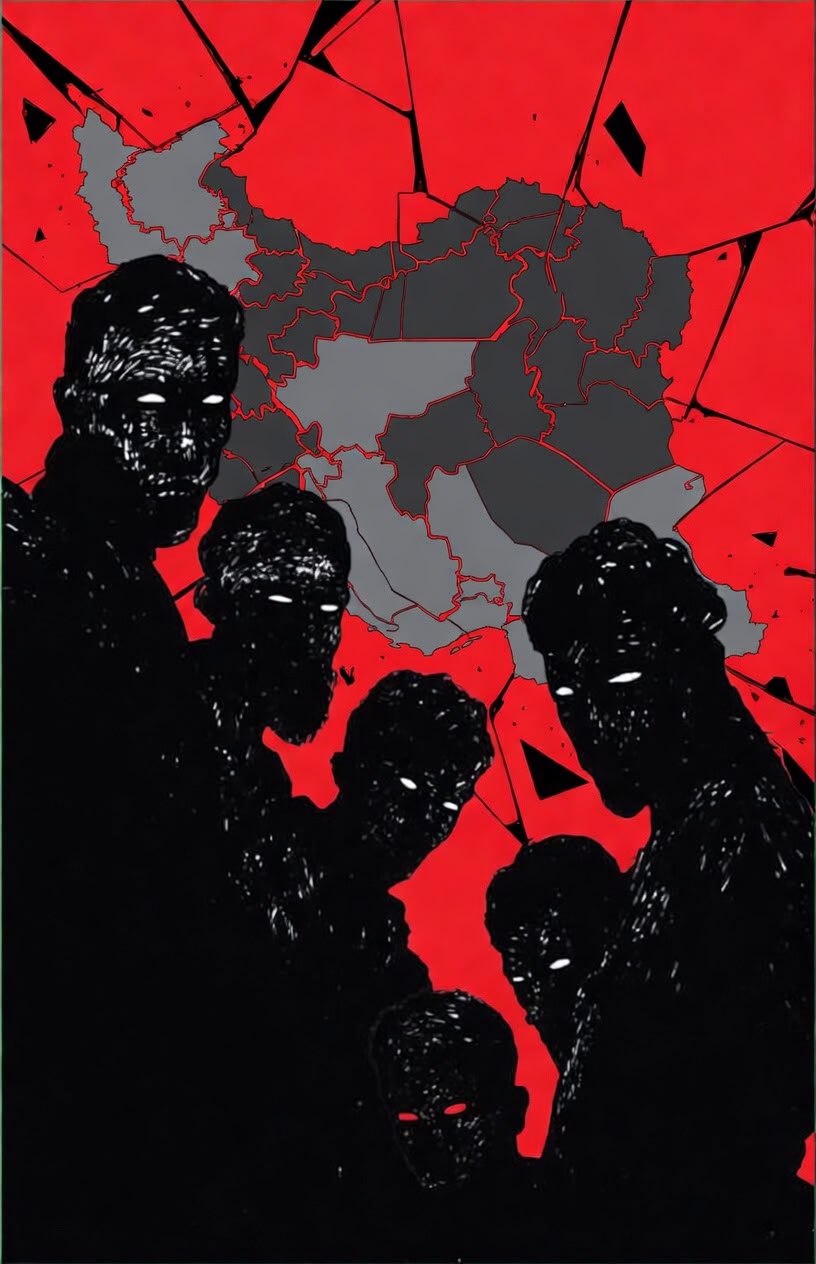
The regime’s treatment of ethnic and religious minorities—treatment that in several documented cases meets the legal threshold of genocide under the 1948 Convention—has created armed, experienced insurgencies on every border that will turn inward the moment central authority cracks. Iran is not a monolithic Persian state; it is a multiethnic empire in which Persians constitute barely half the population, and Kurds, Azeris, Baloch, Arabs, Turkmen, and Lurs each carry distinct historical grievances that the Islamic Republic has deepened rather than resolved.
These groups share a critical characteristic: they hate Tehran far more than they hate each other. The 1980s annihilation campaigns—the mass executions of Kurdish political prisoners after the revolution, the chemical bombardment of Sardasht (the only city besides Halabja to be gassed with chemical weapons in the Iran-Iraq War, this time by Iran’s own strategic negligence), the systematic assassination of Sunni clerics in the so-called “chain murders” of the 1990s—have never been forgotten, never been addressed, and never been forgiven. When the Persian core of the regime finally stumbles—whether through military defeat, economic collapse, or succession crisis—the periphery will not submit petitions for autonomy or request seats at a constitutional convention. It will settle for revenge. And the road from Zahedan to Tehran, from Sanandaj to Isfahan, is shorter than the mullahs have ever allowed themselves to believe.
V. The Torture Generation: Nothing Left to Lose
The systematic rape and torture of political prisoners have produced a generation that has nothing left to lose and everything to gain from revolutionary justice—a generation that will not be bought off with reform promises or constitutional amendments. The Islamic Republic’s carceral apparatus is not an incidental feature of the state; it is the state’s central governing mechanism, and it has been producing enemies faster than it can bury them.
The testimonies emerging from Evin Prison, Gohardasht (now renamed Rajai Shahr in a transparent attempt to erase its history), and the classified wards of detention facilities in Mashhad, Shiraz, and Ahvaz are no longer whispers exchanged in exile communities. They are megaphones, amplified by smuggled smartphones, satellite internet, and a diaspora that numbers over four million. Survivors of Kahrizak (2009) have published accounts of mass rape, beatings with cables, and prisoners forced to lie on blocks of ice until their kidneys failed. Survivors of the 2022–2023 crackdown have documented what Amnesty International has termed “the systematic use of sexual violence as a weapon of political repression,” with female protesters subjected to rape by interrogators in facilities operating under the direct authority of the judiciary and the Intelligence Ministry.
The psychological and political implications of these revelations cannot be overstated. When a society discovers—not suspects, but discovers, with video evidence and survivor testimony—that its daughters were violated in basements bearing the portrait of the Supreme Leader, the psychological threshold for violent retribution against the responsible officials is crossed permanently and irreversibly. That threshold was visibly crossed during the 2022 uprising when protesters in Isfahan hanged a Basij commander’s effigy from a construction crane and posted the video to social media with a single-word caption that requires no translation: “Practice.”
The academic literature on post-atrocity societies, from Rwanda to the former Yugoslavia, demonstrates a consistent pattern: when institutional justice is unavailable—when there are no functioning courts, no truth commissions, no possibility of lawful accountability—popular justice fills the vacuum with a ferocity that is directly proportional to the duration and severity of the preceding repression. Iran’s forty-five-year experiment in state terror has ensured that the popular justice awaiting its perpetrators will be of a character and scale that will shock even hardened observers of revolutionary violence.
VI. The Turban as Target: Islam’s Destruction by Its Own Custodians
The clerical caste has accomplished what no external enemy of Shia Islam could have achieved: it has destroyed the faith’s moral credibility inside its own heartland, transforming the Shia tradition from a source of popular legitimacy into an object of widespread contempt and, increasingly, active hatred. This is perhaps the Islamic Republic’s most consequential legacy, and it guarantees that the clergy will not be spared when the regime falls.
The hypocrisy is not subtle; it is architectural. Friday prayer leaders who deliver sermons on austerity and self-sacrifice while wearing bespoke Italian suits and Swiss watches; senior ayatollahs who issue fatwas criminalizing lipstick and music while dispatching their own children to universities in London, Toronto, and Los Angeles; a Supreme Leader who lives in a compound estimated to be worth hundreds of millions of dollars while lecturing the nation on the spiritual virtues of poverty—these contradictions are not lost on a population that possesses the oldest continuous literary tradition in the Islamic world and a cultural instinct for detecting charlatanry that predates the Arab conquest by a millennium.
During the 2022 uprising, women burned hijab billboards bearing the image of Supreme Leader Khamenei while crowds chanted “Mullahs get lost!”—a slogan that would have been psychologically unthinkable a decade earlier and that represents a fundamental rupture in the relationship between Iranian society and institutional Shia Islam. Mosques in many cities now stand effectively empty on Fridays because attendance is perceived not as an act of piety but as an act of political collaboration. Seminary students in Qom report declining enrollment and increasing hostility from local populations. The sociological data, to the extent it can be gathered under conditions of censorship, suggests that Iran is undergoing the fastest secularization in the recorded history of any Muslim-majority society—and that this secularization is driven not by Western cultural influence but by direct, lived experience of theocratic governance.
When the regime falls, the settling of scores will not spare the clerics who provided the religious imprimatur—the velayat-e faqih doctrine, the sharia justifications for execution and flogging, the Friday sermons celebrating the murder of protesters—for four decades of theft, repression, and systematic cruelty. History offers a template: in liberated France in 1944, women who had collaborated with the German occupation were publicly shaved and paraded through the streets. In Iran, the collaborating clergy will face their own version of l’épuration, and the black robes and white turbans will be stripped in public squares with a fury commensurate to the depth of the betrayal they represent.
VII. The Regime’s Final Error: Teaching a Nation How to Revolt
In an irony that would be comedic if its implications were not so lethal, the Islamic Republic’s own propaganda apparatus has inadvertently provided the Iranian population with a comprehensive education in the mechanics of revolutionary regime change. Every year, on the anniversary of the Shah’s fall in February, state television broadcasts archival footage of soldiers refusing orders, SAVAK intelligence officers being lynched by crowds, and the old monarchical elite fleeing to airports with suitcases of cash. The mullahs intended this programming as a celebration of their own revolutionary triumph and a reminder of their ideological legitimacy. What they have in fact been broadcasting, for forty-five consecutive years, is a masterclass in how populations overthrow governments—delivered free of charge to a nation that now possesses smartphones, satellite dishes, VPN software, and an intimate, personal understanding of why revolutions happen.
Young Iranians have supplemented this state-provided curriculum with independent study. They have watched, in high definition and in real time, the fall of Muammar Gaddafi in Libya (2011), the initial phase of the Syrian uprising before foreign military intervention obscured the domestic dynamics (2011), the execution of Ceaușescu in Romania (1989), and the collapse of the Soviet Union (1991). They have analyzed these events with the analytical rigor of war-college students, because for them the subject matter is not academic—it is existential. They know the critical variables: that once the security forces begin shooting each other, or simply abandon their posts and go home, the end comes in hours, not months. They know that the transition from regime stability to regime collapse is not linear but exponential—a phase transition, like water turning to steam, that appears gradual until the moment it becomes instantaneous.
The infrastructure of accountability is already in place. The lampposts of Tehran are tall, sturdy, and conveniently spaced along Enghelab (Revolution) Avenue, Valiasr Street, and every major boulevard in the capital. The cranes that the regime has used for decades to conduct public hangings of dissidents, homosexuals, and petty criminals are familiar instruments whose operation the population understands intimately—because the regime itself taught them. These lampposts are awaiting the oppressors of people. All that is missing is the decisive trigger: the military defeat, the economic collapse, the succession crisis, or the unpredictable spark that will cause the enforcers to drop their weapons and the people to pick up their ropes.
Conclusion: The Real Iranian Power
When that moment arrives—and the weight of evidence presented in this essay suggests it is a question of when, not if—the foreign-policy establishments of Washington, London, Brussels, and Tel Aviv, which have spent decades analyzing, fearing, and attempting to contain Iranian state power, will discover that they fundamentally misidentified its source. The real power in Iran was never the Revolutionary Guards’ ballistic missiles, or Hezbollah’s rocket arsenal, or the Quds Force’s network of regional proxies, or the nuclear centrifuges spinning beneath the mountains of Natanz and Fordow.
The Iran leaders created the grievances, demonstrated the methods, supplied the justifications, and eliminated every possible alternative to violent retribution. They did not merely fail to build a safety valve; they welded the pressure vessel shut and continued adding heat. The explosion, when it comes, will be entirely of their own manufacture.
The atonement of Iran’s rulers will not take place in a courtroom at The Hague or in the chambers of a truth-and-reconciliation commission. It will take place in the streets they once controlled, lampposts will be administered by the people they once tortured, and conducted with the tools they themselves perfected. Whether one views this prospect with satisfaction or horror is a matter of individual moral temperament. That it is coming is a matter of political physics.
The lampposts of Tehran will be tall