Consequences of the Naval Blockade and the Claimed Figures of National Gasoline Production
Pejvak Kokabian
The naval blockade of Iran reveals the deceitful manipulation and statistical fabrication of the Iranian system, and the naval blockade of Iran will expose many of the claims of self-sufficiency and the capabilities of the centrists’ economy.
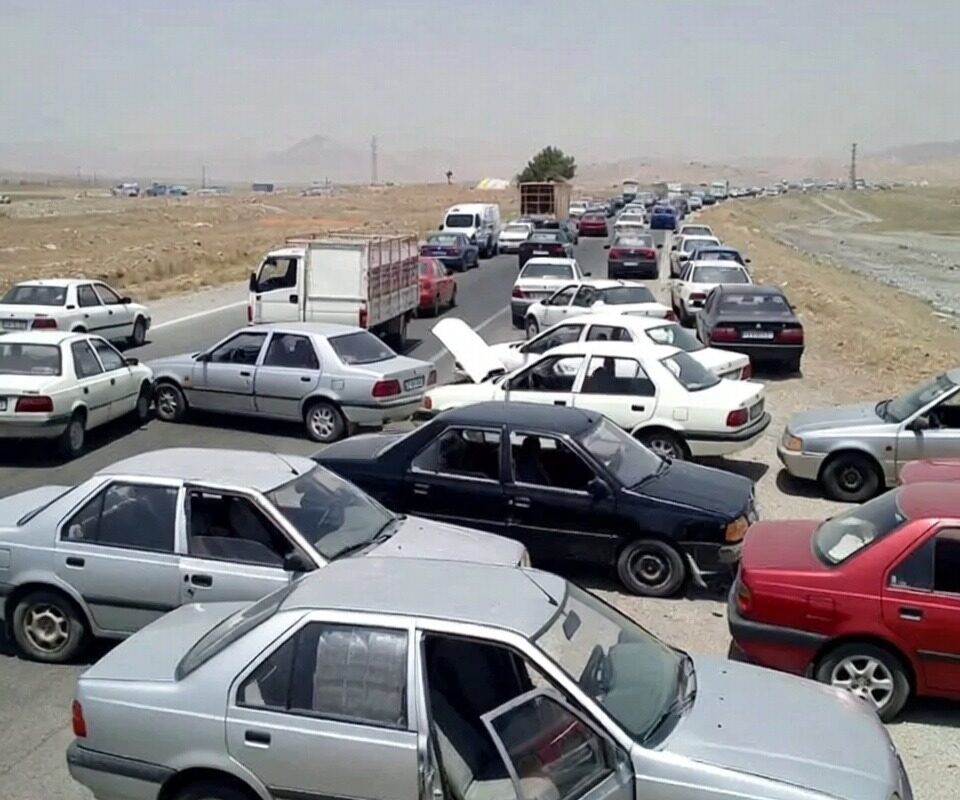
Soon, when the people of Iran abandon their cars in the middle of roads and highways due to the lack of (imported) gasoline and are confronted with the scene of a highway cemetery of automobiles, they will realize the forgery and charlatanism of the Iranian regime governance.
The American naval blockade will show the people of Iran and the world that many of the government’s statistics and exaggerations are nothing but lies. It will prove that Iran’s economic independence is nothing more than an illusion and that it is the Iranian government that, in practice, pays political support tribute through the import of gasoline from Europe and other producers, and that the bulk of this rhetoric about self-sufficiency is entirely baseless.
If Iran’s infrastructure are attacked by Western allies, in the gasoline-free day after, the Iranian government will claim that the reason for the lack of gasoline is the attack on infrastructure. But the reality is that Iran imports 60% of its (proper-quality) gasoline needs and only refines and produces 40% domestically. The truth is that, like many other goods whose import volumes from abroad are ambiguous, the majority of consumed gasoline is imported into the country, but the real production statistics are always censored. The lack of transparency and precise statistics is because Europe and China receive Iran’s oil at a discount and a fraction of the global price and, in return, give back a fraction of that volume in the form of gasoline. The ambiguity in these statistics is intentional so that the degree of fragility of self-sufficiency in gasoline production is not revealed; meanwhile, the European side can also under-report its trade statistics with a sanctioned Iran.
After the recent US-Israeli war, the European public has now realized that the reason for high fuel prices in Europe is the failure to receive cheap oil from Iran. The oil plundered from the geography of Iran will not reach Europe after the naval blockade of Iran by the United States.
If the U.S. government targets what Iran refers to as its infrastructure, then for the next 1400 years, every Iranian will blame the West and America for their backwardness. Unfortunately, given the Eastern culture of projection, Iranians have often been unwilling to accept responsibility for the actions and consequences of their own policies, just as after 1400 years since the Arab invasion, they still project their laziness, corruption, and backwardness onto the Arabs and Islam.
The History of Economic Statistical Fabrication in Iran and the Colonial Rule of the Persian Center over the Periphery
Economic statistical fabrication has been a weapon for the continuation of colonial rule and the perpetuation of the Stockholm syndrome of the Persian settlers over the non-Persian peoples of the periphery.
The fabrication of statistics and the forgery of numbers are intended to downplay the leverage and weight of the productive economies of non-Persians (the periphery) and to instill the idea that their production is not a significant part of Iran’s overall economy. The Persian centrists, by controlling the media and inculcating the periphery’s inability, constantly inject them with Stockholm syndrome, suggesting that if it weren’t for the central Iran factories and workshops to plunder the raw materials (water, oil, mines, grains, etc.) and cheap labor of the periphery, the people of the periphery would die of starvation. Thus, this arrangement and system of plunder and colonialism of the periphery is made to seem justifiable. Concurrently, by controlling the printing of money by the Persians, the value and weight of the real and physical economy’s production in the non-Persian periphery are shown to be less than the paper, fiat based economy of the Persian settlers.
The Promise of the Gateway to Civilization
In his speeches, Mohammad Reza Pahlavi always promised Iranians they would reach the “Gateway to a Great Civilization” and portrayed the country’s prosperity and progress as conditional on top-down, command industrialization.
The reason for this creation of an industrialization illusion and the promise of approaching the “Gateway to a Great Civilization” was all to persuade non-Persians of modernity in order to continue the plunder of their resources and lands.
Both the first Pahlavi, the second Pahlavi, and the existing Shia regime have always sought to instill the illusion that the country’s advancement and industrialization are achieved through the industrialization of the central and Persian geography. Meanwhile, the Persians have been unwilling to accept the undeniable laws of economics: that raw materials and cheap labor must be close to the factory and production unit, and both must have access to ports, customs, and borders for the goods to be cost-effective and competitive for foreign markets. Unless, of course, they continuously devalue the national currency (at the expense of the peripheral laborer and wage earner, and the non-Persian employees of Iran’s administrative system) to make the finished cost of the goods appear cheaper in dollars. This, too, only temporarily makes the price of the goods profitable and justifiable for export, allowing them to be exported to war-torn markets like Afghanistan and Iraq in the form of simple goods (without technology). These exports can only continue as long as those countries remain at war and their factories for simple goods are not activated. Now we understand that Qasem Soleimani’s mission to export war and chaos to Iran’s neighbors was so that substandard Iranian goods could find a market there.
Lies in Other Statistics, Including Wheat and Grain Production
The same issue exists with wheat self-sufficiency statistics. More than 65% of Iran’s wheat is produced in the lands of Kurdistan, and the rest is imported with oil currency. However, in the statistics, there is always the fictional claim that over 50% of the wheat is produced on the farmlands of the centrists. The presentation of these false statistics is intended to humiliate and devalue the productive weight of the peripheral peoples and the Kurds, while they secretly import the remaining 35% of the wheat with oil dollars (Oils which are extracted from the Lurs, Arabs, and Kurds lands) but fudge the numbers in official statistics to count it as domestic production.
For the issue of wheat, please refer to the interview with Issa Kalantari and my book.
Ports and the Colonized Periphery in Iran
In all countries of the world, ports and border cities are the core and heart of their economic prosperity. However, in colonial Iran, due to the presence of a non-Persian population, these regions have, without exception, remained poor, backward, and underdeveloped.
The ports of Osaka in Japan, Shanghai in China, the ports of Malaysia, Mersin, Izmir, and Istanbul in Turkey, Manchester in England, Barcelona in Spain, Venice, Milan, Turin in Italy, and the wealthy East and West of the United States and Canada—all attest to the natural flow of wealth generation in these healthy and active world economies. The deliberate backwardness of the periphery’s geography in Iran is rooted in the economic fascism of the dominant ethnicity – Persians, and this economic order and arrangement has been perpetuated so that the balance of economic power between the centrists and the periphery does not undergo a transformation.
Not only can they not bear to see the periphery prosper, but they cannot even bear to see the prosperity and progress of their Arab neighbors. The reason why the United Arab Emirates and Iraqi Kurdistan have been subjected to more missile and drone attacks than Israel lies in the jealousy and narrow-mindedness of this self-aggrandizing, self-centered worldview.
Benefits of European Colonialism from the Monopoly of Trade with Iran
Over the past 40 years, due to the sanctions imposed by the United States on Iran, European countries have reaped very significant benefits from their exclusive trade with the Iranian government. The reasons for Europe’s immense profits from trade with Iran go far beyond this writing, but this section will only touch on two major areas.
Europeans have profited immensely from the geography of Iran both through selling goods and services and through bankers and the financial world. These countries have benefited from the trade of goods and services in Iran’s unchallenged market, and European banks and the cartel of European bankers have made huge profits from the issuance and injection of the Euro into the European and global economies.
Europe’s colonialism and exploitative trade relations with Iran go back more than 50 years. During this time, British, German, French, Swiss, and other European companies have gained numerous exclusive advantages from Iran’s command and top-down trade and non-competitive government purchases with Iranian parties.
These companies have generally profited from the Iranian geography’s market with higher selling price and lower quality compared to other competitors (mainly in Asia). In many cases, especially after the establishment of sanctions during the Bill Clinton era, practically no money was returned to Iran, and the bulk of the trade remained in the form of credit exchanged in European banks. In fact, instead of paying Iran at the global currency price, the Europeans imposed barter and counter-trade with Iran at a higher cost.
This includes all those companies (security equipment sellers from Spain, manufacturing from Italy, automotive from France, machinery from Germany, weapons from Eastern Europe, telecommunications from the Netherlands, and financial-exchange services from Canada) that have dealt with Iran. The reason for such diversity and transactions by European companies is that, in order to conceal the numerical value of the transactions (to avoid being identified for violating sanctions against Iran by these offending companies), Iran, instead of receiving oil money in Euros, (in coordination with Swiss, German, and British banks) opened an equivalent letter of credit (LC) as a savings account in a European bank, from which deductions are made when European companies send goods and services.
Parallel to the goods and services companies, European banking and financial institutions have made enormous profits from the use of the Euro, to the point where the dollar’s position in international transactions has been shaken.
For example, according to the Basel II and III regulations, for every Euro held in Eurozone banks, European investment banks can inject liquidity into the market at a multiplier of 10 to 20 to 50 times. This, in the form of bank loans, letters of credit to companies, or sovereign/treasury bonds (loans to world governments), has given new financial life to economies that work with the Euro. The monetary and Euro equivalent of transactions and oil transfers in the Strait of Hormuz region, assuming a monthly circulation of 15 billion Euros, will practically generate 150 to 300 billion in monthly financial credit denominated in Euro, issued by them for the European Union’s economy and all countries that exchange with the Euro. This is the lifeblood of Europe’s survival. The reason for Europe’s nearly 50-year colonialism in Iran is perfectly clear.
In conclusion, it must be noted that the gains for Europe and China are so immense that they have been unwilling to align with other Western countries to dismantle such a repressive, despotic, and plundering regime.
But the question is: when will Iranians be forced to abandon their cars on the roads?
Resources:
A – Co-colonialism, Kokabian Pejvak, 2022.
https://www.amazon.com/Cocolonialism-Near-Colonizer-Far-ebook/
The electronic Farsi version of the book can be downloaded from here.
https://www.kurdia.net/wp-content/uploads/2022/04/cocolonialism-farsi-for-ebook-pejvak-kokabian-encry.pdf
B – Issa Kalantari’s criticism of statistical fabrication in the agricultural sector: “They have assumed people are animals”
https://nedayeazady.wordpress.com/%D8%A7%D9%86%D8%AA%D9%82%D8%A7%D8%AF-%D8%B9%DB%8C%D8%B3%DB%8C-%DA%A9%D9%84%D8%A7%D9%86%D8%AA%D8%B1%DB%8C-%D8%A7%D8%B2-%D8%AC%D8%B9%D9%84-%D8%A2%D9%85%D8%A7%D8%B1-%D8%A8%D8%AE%D8%B4-%DA%A9%D8%B4%D8%A7/