Pejvak Kokabian
Lost in Iranian Ballyhoo: Is It Muslim Ban?
A History of Covert Iranian Terror Operations Abroad for Last 40 Years
The community of Iranians shape one of the largest share of immigrants in the US out of seven countries in the executive order. During recent visa ban on Iranian visa holders, the widespread hype has been orchestrated with tacit Persian influence over academia, officials, and professionals in the country. According to statistics and reports, Iranians have not been committing a direct act of terror inside United stated. However, reports fail to address the indirect support of terror by Iranians. It was after 1979 revolution; Mr. Tabtabaei whom was murdered on US soil in Maryland on July 1988 by an agent paid by Iran, afterward he fled to Iran. Years later, the murderer acted in an Iranian movie on Afghanistan subject (Kandahar 2001).
Eight years later, in 1988, when US Navy ship, the Vincennes, directly exchange the fire and shoot down the Airbus 655, the US actually become involved in a direct fight with Iran. In this case, Iran performed a revenge in an indirect and tacit way, a few months later Pan Am Flight 103 exploded over Scotland by paid Libyan nationals, later a defector confesses that Iran was behind the plot. Politically immature governments may get involved in direct sabotage and overt terror activities,however states like Iran with resources can obtain assassination services from third party and mafia groups and perform covert agendas, the case of Mr. Arbab is the latest incident.
In this paper, author sheds lights on methods and strategies in which Iranians utilize to spread terrorism and impose their initiatives.
This article addresses only Mr. Trump immigration ban on Iranians with visas.
Abstract
This article addresses only President Trump immigration ban on Iranians with visas.
Iranians shape the biggest share of immigrants in the US out of seven countries in the executive order. During recent visa ban on Iranian visa holders, the widespread hype has been orchestrated with tacit Persian influence over academia, officials, and professionals in the country. According to statistics and reports, Iranians have not been committing a direct act of terror inside United stated. However, reports fail to address the indirect support of terror by Iranians. It was after 1979 revolution; Mr. Tabtabaei was murdered on US soil in Maryland on July 1980 i by an Iran agent, and he fled to Iran. Years later, the murderer played in an Iranian movie (ii).
Eight years later, in 1988, when US Navy ship, the Vincennes (iii), directly exchange the fire and shoot down the Airbus 655, the US involved in a direct fight with Iran.
Iran revenge in an indirect and tacit way, a few months later Pan Am Flight 103 exploded over Scotland by Libyan nationals, later a defector confesses that Iran was behind the plot (iv).
Poor governments may get involved in direct sabotage, but rich states can obtain assassination services from the mafia, the case of Mr. Arbab is the latest incident.
Tale of Three Filmmakers; one Persian and two Kurdish
Asghar Farhadi, an Iranian director, winner of Oscar award, he is a national pride for Persians. Due to the visa ban, Mr. Farhadi protests his attendance to Oscar Academy due to President Trump executive order. This created a hype among news media. Mr. Farhadi started his movie career when he was a young IRGC member (Islamic Revolutionary Guards Corps) house of cinema branch in the early 1979 Iranian revolution (Today IRGC is a foreign arm of the almost majority of Iranian military operation in Yemen, Iraq, Syria and Lebanon). He belongs to Persian ethnicity, and he has not criticized the regime directly from the beginning of his career. Mr. Farhadi is allowed to travel outside Iran whenever he wants to, attends festivals. Almost none of his movies address human rights issues in Iran or atrocities committed by the Iranian state. His announcement of non-participation goes viral throughout Farsi-speaking media.
Bahman Ghobadi, a Kurdish director born in Iran, one of the prominent Kurdish filmmakers who has won numerous awards, is outspoken, and is critical of Iran treatment toward minorities. “Since I began shooting my films, I have never been able to let my guard down”, laments Bahman Ghobadi. “After the movie Marooned in Iraq (2002), I was called in by the security services and interrogated five times. After Turtles can fly (2004), I have questioned again and told that the film was pro-American” (v).
Mr. Ghobadi is arrested and sent to prison. He was turned loose and told go (self exile), and do not come back. “I don’t want to be treated like a second-class citizen – if I go back to Iran, they might send me to jail, maybe they will decide to confiscate my passport.
In any case, I know they will do everything they can to try to make sure I cannot make a film”(vi). Kurdish director’s passport was not renewed by Iranian authorities due to critical movies he made. Indeed, his expired passport was not good, and he faced critical legal residency issues worldwide. One of the most famous directors of the Middle East had no place to reside. He was frequently flying from a country to another country with temporary residency permit until last month, Martin Scorsese, American director, a friend of Bahman helped him and appealed for a valid US permanent residency for Bahman. Released in 2000, A Time for Drunken Horses is a brilliant move on the situation of Kurds and Kolbars (Kurdish courier worker) in Iran.
Keywan (Keyvan) Karimi (vii), 31, another Kurdish filmmaker from Iran, two of his documentaries, Marz-e Shekasteh (Broken Border) about Kolbars (viii) and Zendegi-e Zan va Shohar (The Life of a Husband and Wife) has won numerous international awards. He is found guilty of “insulting the sacred and spreading propaganda” in a documentary about political graffiti in Tehran called,” Writing on the City.”
According to the Amnesty report, Karimi’s Kurdish and Sunni background also contributed to his harsh sentence (ix). Iran’s Kurdish ethnic minority and Sunni Muslim religious minority are subjected to significant discrimination and persecution (x).
Tehran is the only capital of the world with no mosque for Sunnis. On the paper, his sentence is for making documentaries, but infecting fear and self-censorship into to both cinema and Kurdish community is subtly goal of authorities; Iran indirectly deploys his power to crush dissident.
Mr. Farhadi can easily submit his movies to international film festivals (under Iran name, which means the government approves the director to represent the country image) while Mr. Ghobadi or Mr. Karimi are being tortured, jailed, and exiled. Mr. Farhadi is helping Iran using tacit warfare; he may not realize it. He protests a festival which he is not invited to yet. Indeed, it produces publicity for him and Iranians.
Tale of a Kurdish university professor and Persian academics Zakaria Qaderi was born in a Kurdish town; he received BSc and his Master and Ph.D. in Political Science. He is a distinguished Kurdish scholar who has written extensively (xi) on the history of Persia, Kurds, and the Middle East. Mr. Qaderi decides to flee Iran through mountains overnight after receiving death threats by the Iranian authorities for writing an essay (xii) about Islam in a bilingual literary and cultural magazine, Zirebar (xiii). He has fled Iran on Jan 7, 2016, and he is living a hide and run lifestyle in Iraqi Kurdistan fear of his life up to this moment. He resides inside Iraqi Kurdistan, where Iranian agents hold 700 safe houses according (xiv) to Harvard
researcher, Dr. David Pollock. “Iraq’s Kurds have no other choice but to yield to a certain degree of Iranian leverage” he explains. Iranian Kurds like Mr. Qaderi has to hide and live a secret life in Iraqi Kurdistan due to the overarched arm of Iran in the two regions. Interestingly, it was a month ago, when a bomb exploded in one of Kurdish parties’ camp inside Iraqi Kurdistan; killed seven Peshmerga and all fingers point to Tehran (xv). Apparently, Iran never took responsibility for the incident, but everyone in Iraqi Kurdistan see Iran’s hand.
Mr. Qaderi could have been enjoying his educational journey in the US if he was not a Kurd, but his scholarly progress was stopped by implicit red tapes (existence of discriminatory laws toward minorities) and later by convicting him over an article.
[as of 2025 – Dr. Qaderi has been murdered in Germany in 2024. The cause of death has been reported in the car accident, and Iranian authorities have forced the family in Iran to announce the death naturally.]
Mr. Qaderi is lucky to be still alive. But Dr. Sharafkand (ixvi), Dr. Ghassemlou (xvii), Sunni cleric Mr. Moftizadeh (xviii), Farzad Kamangar (xix) (Kurdish language teacher), Ehsan Fattahian, Shirin Alamholi (xx) and hundreds were not (xxi). They were Kurds and had to be a victim to quell the community.
A university teacher, Persian-native, H1B visa holder, from Stevens Institute frequently travel to Iran, he presents workshops, attends state-run TV programs and offers training classes for Iranian professionals on topics of governance, finance, and economics. The economic system of Iran is a state-run economy, giving consultation in a top level turn into an illicit way of helping the government once the
majority of participants are government officials. What happens is an indirect transfer of knowledge to the foe. Since there is no access to another side of the world, achieving court satisfactory evidence is near to impossible.
An Iranian, Nader Modanlo, comes to the United States, studies engineering, works, and gets experience in satellite and aerospace technology. He makes frequent contacts to Iran, Switzerland, and Russia to close a business deal of $10 million dollars. Mr. Modanlo was convicted of doing illicit business with Iran (xxii). Iran built his first transponder satellite. Its satellite is helping Iran to navigate and manage
drowns who can kill Iranian dissent in Iraq and Yemen, including American soldiers. Mr. Obama requested Iran to return the American drone (xxiii), which was captured by Iranians.
Another senior Iranian fellow from Princeton University, Seyyed Hossein Mousavian (xxiv), a former Iran ambassador to Germany between 1990-1997 during assassination of Kurdish dissidents in Mykonos restaurant , visit officials several time xxv, to help and lobby for Iran government. He has blood on his hands (xxvi). While working on behalf of the Iranian government, he joins and works with the director of NIAC, the National Iranian American Council, and a prominent official lobby group for Iran (xxvii). Surprisingly, Iran does not have diplomatic relation with the US, but its government can lobby via NIAC, an organization that is run by a director who is not even Iranian-American; not an American citizen, but holds Iranian and Swedish passports. This is a form of tacit warfare in which America is involved.
Iran selectively let professionals travel freely abroad, thanks to subsidized, disproportionately and discriminatorily Arze Daneshjooe (subsidized US dollar distribution to students abroad) program; a program which dispense US currency to Iranian students (who study abroad) to fund their education. Some of these students return government favor in other forms.
The Iranian regime is using passport issuance power to take non-conforming Iranians as a hostage. If you belong to minorities, especially Kurdish, a harsher punishment is expected (xxviii). Authorities can make an individual a person of no-land.
U.S. Department of State has pursued a policy, since the mid-2000s , to engage Iranian students and promote American university education. The message was clear: democracy, human rights, and student exchange are intimately linked. But previous administration miscalculated the consequence of accepting students from a country when basic requirements to start a dialogue were not there. The previous administration thought that by exchanging student; democracy would flow into Iran, while 89% of students intend (xxix) to stay in the United States.
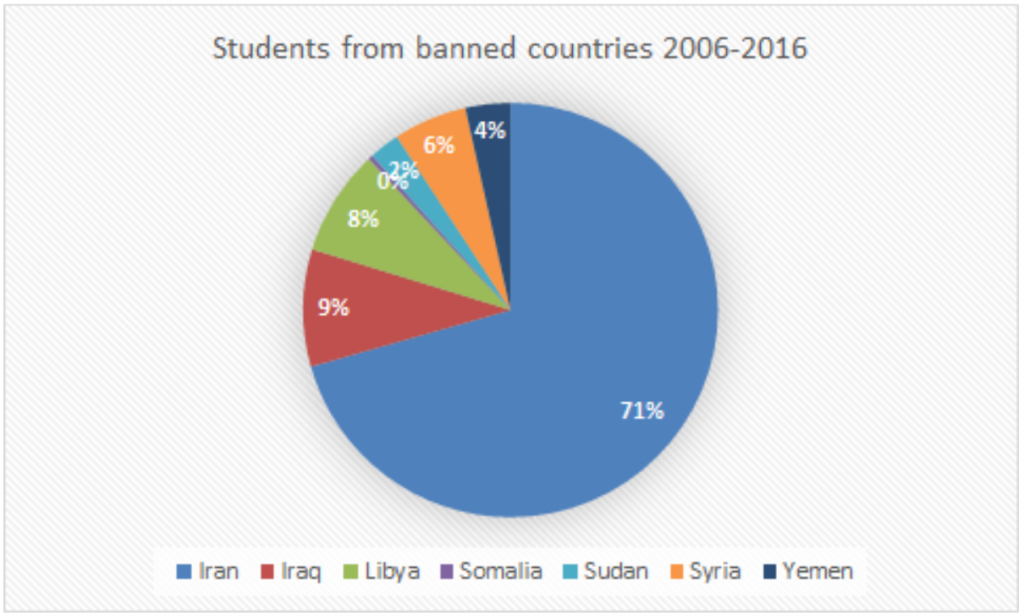
According to statistics xxx and reports, currently close to 480,000 Iranian immigrants live in the United States. This number does not include green card holders or non-immigrant visas. According to the Institute of International Education data, since 2006, almost 71% of all country-banned students are Iranians (xxxi). A detailed table of International Student by place of origin between 2006-2016 follows below.
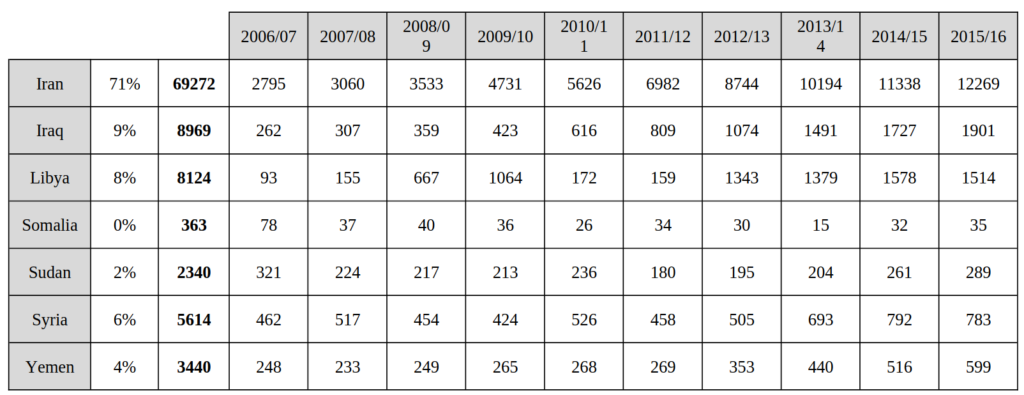
Iran is the most affected country among visa-banned countries as it depicts below.
First strategy: Crush the weak into pieces
During the uprising of non-Persian ethnicities right after 1979 revolution, Kurds, Arabs, and the Turkmen community protested. To silence the nation and to give the rest a lesson, Iranian authorities vanquished Kurdish cities (xxxii) and sent tanks into their cities. In the case of Turkmen community, the regime peeled off the skin of four Turkmen rebel leaders and left their corpses in public view under a bridge (xxxiii). Turkmen never voiced any opposition since then; literally, they disappeared from political life and even news headlines.
Iranian history (Qajar, Safavids…) is filled with the barbaric punishment of the weak to quell mass opposition. Kurds are targeted, and the regime knows that the collective consciousness of Iranians is less sensitive to Kurds and Baluchs. Kurds and Baluchs are least likable among ethnicities due to their upfront and outspoken characteristic. They have two distinct differences with the rest of Iran, they are not Persian, and they are Sunni. They do not belong to a lowlander mindset. Historically, they have resisted and rebelled more often against despot and tyrant regimes since 621 A.D. Today, Kurds and Baluchs’ community feel an existential threat in Iran. Iran subtly runs mass silencing and murdering Kurdish population at home to quell others.
In warfare, Iranians’ first strategy is to crush weak foe into pieces.
Second strategy: tacit warfare
As a rule, despot system of governance produces a different culture of disagreement and discord, since openly discontent toward government cost human lives. Throughout history, Persians have avoided direct confrontation with strong enemies, they have dissolved enemy into themselves. Mongols and Arab were dissolved over time. The only confrontation for last three hundred years is after Kurdish and Arab lands annexed to western Iran, and they were the forefront of war with Iraq’s Saddam. Arabs and Kurds paid the cost of Persian rulers’ war with Iraq with the destruction of their cities and geography. Once for 53 days Iraq targeted Persian-dominated cities Qom, Isfahan, Karaj, Shiraz and the capital, Tehran, with long-range missiles, Iran accepted the UN Resolution 598 to cease the war (xxxiv). Eight years war ended when Persians incur direct cost and threats.
The majority of Iranians would like to hedge their bet by having access to both Iranian passport and the United States (xxxv) residency. Due to ancient despotic and centralized rule, Iranians obliged to live a double life. Despotism alters mindset, behavior, and incentives. Historically people of Iran had to adapt to the new ruler, little is left to hold the constant position of the rightfulness of a subjectxxxvi says an
analysis.
Expat Iranians need to comply with regime standards if they travel back to Iran, while intend to live in western democracies. However, Iranians who attempt to enjoy all freedom and opportunities of western democracies should not overlook horrible inhumane conditions of other communities inside Iran. Astonishingly, Iran is second to Turkey in refugee applicants to Europe. While on-going atrocities inside Iran go unnoticed, a temporary ban on visa holders catches tremendous publicity from American news outlet; it overwhelms 14-day president. The new executive order puzzlingly faces silent from the rest of affected countries (xxxvii). The Shia-majority government of Iraq announced a retaliatory measure but never ratified. Only Iranian government voices their concern. Even UAE foreign minister denies that orders are toward Muslims (xxxviii).
The majority of current airports’ publicity around President Trump order may contribute to influence of Iranians over academic personalities, professional groups and company executives in American organizations. Iranians are in a war with executive orders but in a different way, amassed behind petitions, email campaigns, CEO memos, ACLU contributions (It increased by six-fold compared to last year), NAIC interviews (xxxix), academic circles and Silicon Valley executives (xl). The new administration was not ready to face tacit warfare tactics. Iranian implicit warfare techniques are very ancient and skillfully being applied to new administration. Iran employs foreign fighters from Afghanistan, Pakistan, and Iraq to fight in Syria (xli).
Each part of Iran is much different from another. Iran is a country of different ethnicities that each have separate cultural, language, geography, and psychological makeup. Since 1925, only one group of ethnicities, Persians, dominated politics, media, government, and resources.
Iran is a land of lowlanders and highlanders. The highlanders are those who live in mountains and lowlanders, those who use tricks instead of chivalry to fight opponents, says Dr. Izady (xlii), a Columbia scholar. There is an ongoing unnoticed war inside Iran between dominant lowlanders and colonized highlanders. Last August; Iran executed 20 Kurds in prison in one single day (xliii). Families of some of the prisoners received the corpses of their loved ones, but the exact number of the executed never confirmed. In 2015, Iran was the second highest executioner in the world (xliv).
While representing only 10% of the population, Kurds as a part of highlanders Iran, collectively being murdered every day. More than half of political prisoners are Kurdish (xlv), Iran is casting out them slowly and continuously; physically and colonizes them economically. Kurdish people have to cross-border (Kolbar) to make a very small living and constantly being shot by the Iranian security forces.
Amnesty International reports that the continuation of capital punishment “demonstrates the Iranian authorities’ utter disregard for the right to life.” Amnesty added that Iran is determined to continue their “staggering execution spree that saw nearly 1000 people put to death last year.”(xlvi) The majority of them are Kurds.
Iranians have been pushing Nobel prize winners, media, democratic institutions, and even senators to intensify recent protests. It would had been more productive if talented, intelligent people could use skills to remake the home country. It would be better to voice their concern toward Iran’s geography, where records of ethnic cleansing, racial profiling, and discrimination of other ethnicities are almost one of the worst in a world record. American activists and friends of freedom showed the highest spirit of a humane society by storming into airports and supporting those trapped in airports.
Surely Iran needs good engineers, doctors, teachers, social scientists in Iran for the betterment of fellow Iranians. Those who storm airports and social media criticizing unfair treatment by the new president should voice concern for fellow non-Persian citizens (Baluchs, Arabs, Kurds, Azeris) at home. Iranian visa holders and those who intend to reside in the US should be honest and morally responsible with brethren and fellow Iranians.
While historians connect incidents of Maryland, Pan Am, Iraq, Syria, Yemen, Lebano, and other attacks, the indirect tactic of Iranian feud is observed. General Petraeus and Gen. Flynn may share similar stories (xlvii).
Consequently, last wee, the President of Iran referred Mr. Trump a political novice (xlviii). The new administration assumes good strategy but bad implementation. It was not prepared to Iranian tacit warfare strategy. Due to tacit confrontation strategy of Iran, America does not know where her foe is and when it might attack her, as it hit her at airports. It seems that the executive order designed to hit the US-based Iranian professionals who tacitly support the regime, but it faced a fire back with a Persian tacit warfare.
Recent executive order lost in Persian ballyhoo, this is neither Muslim ban nor refugee ban, but Iran ban. This is a ban on Iranian with dubious connection with Tehran, although public rhetoric converted to Muslim and refugee ban.
The new administration can consider few key elements to improve the visa programs in a short time.
1. A stamp in the birth certificate is a sign of voting in Iran, those who want to live in a free country may not vote for tyrant rulers at home. Voting for a despot regime is a moral hypocrisy. A true entry ban should target those who have voted in despot elections.
2. Those visa holders who were admitted as refugee based on the humanitarian ground, to enjoy American or European democracy, should not apply for Iranian passport again and go back to where they claim escaped from.
3. The situation of human rights violations in Iran is horrendous due to state-wide censorship in Iran, little come out of Iran, and it barely reaches to world news, Kurds and Baluchs are obvious examples. Regrettably, Persian-dominated media outside Iran are too busy storming airports rather than
report human atrocities at home. A UN resolution, similar to what made Iran adopt nuclear deal, can help to protect lives of endangered people. Global commitments toward minorities prevent further genocide, war crimes, ethnic cleansing, and crimes against all people of Iran.
4. Iran enjoys from what in economics called Asymmetric Information, the flow of information, professionals and academic profiles between Iran and American/Western institutions is asymmetric and it looks like a one-way highway. This jeopardizes efforts to have influence over another side of the
struggle, brain trade balance is imbalanced. Iran knows way more about the US.
5. The West needs soft-war specialists, anthropologists, historians, and social scientists to comprehend eastern cultures; this includes a geography from Japan to the shores of the Mediterranean Sea.
Conclusion
The visa ban is not a blanket “Muslim ban” but a targeted measure addressing Iran’s geopolitical tactics and tacit influence. While the policy has drawn criticism, it underscores the need for a nuanced approach to managing threats posed by state-sponsored tacit warfare. By addressing systemic discrimination within Iran and enhancing oversight of international engagements, the U.S. can more effectively counter these challenges.
Source
Kokabian, P, Lost in Ballyhoo: Is it Muslim Ban? (originally published on February 2, 2017). Available at SSRN: https://ssrn.com/abstract=2912017.
Endnotes
i Robert Mackey. (2017) American Who Killed for Iran’s Revolution in 1980 Resurfaces in C.I.A. Spy Drama – The New York Times. Retrieved January 31, 2017, from https://thelede.blogs.nytimes.com/2013/12/13/american-who-killed-for-irans-revolution-
in-1980-resurfaces-in-c-i-a-spy-drama/
ii http://www.csmonitor.com/World/Middle-East/2011/1014/Former-Iran-assassin-says-
alleged-plot-makes-no-sense
iii Wp B. (2017) the forgotten story of Iran Air Flight 655 – The Washington Post. Retrieved
January 31, 2017, from
https://www.washingtonpost.com/news/worldviews/wp/2013/10/16/the-forgotten-story-of-
iran-air-flight-655/
iv Gordon Rayner, Chief Reporter, 10 Mar 2014, Lockerbie bombing ‘was work of Iran, not Libya’ says former spy – Telegraph. Retrieved January 31, 2017, from
http://www.telegraph.co.uk/news/uknews/terrorism-in-the-uk/10688067/Lockerbie-
bombing-was-work-of-Iran-not-Libya-says-former-spy.html
v Middle East magazine. (2010) Kurdish Awakening. Retrieved February 01, 2017, from
http://www.chris-kutschera.com/A/Bahman.htm
vi Ibid.
vii https://en.wikipedia.org/wiki/Keywan_Karimi, accessed 2017
viii Karimi, Keywan. (Dec, 2014) Broken Border, Marze Shekaste , Senuri Shekaw on.
Retrieved January 31, 2017, from https://vimeo.com/115089412
ix Amnesty, Six years in jail for (Kurdish) Iranian filmmaker: Keywan Karimi, Jan 22, 2016,
available at https://www.amnesty.org/download/Documents/MDE1333002016ENGLISH.pdf
x Ibid on Keywan Karimi,
https://www.amnesty.or.jp/en/get-involved/ua/ua/2016ua019.html
xi XAKK(Kurdia) (farsi portal), Zagross website, available at http://www.kurdia.net/wiki/
xii Qaderi, Zakaria and Kokabian, Pejvak, ISIS, Islam and Arab Social Cohesion: Relations
and Connections (January 1, 2016). Available at SSRN: https://ssrn.com/abstract=2756810
xiii Hra. (2015) Zakaria Qaderi | XAK Kurdistan. Retrieved February 01, 2017, from
https://www.kurdia.net/zakaria-qaderi/
xiv Knights, M., and D. Pollok. “The Kurdish Crescent: New Trends In Syria, Turkey, Iraq and
Iran.” URL: http://www.Washingtoninstitute.org/policy-analysis/view/the-kurdish-crescent-
new-trends-insyria-turkey-iraq-and-iran
xv (2017) Iranian Kurdish groups warn of further attacks against them in K. Retrieved
January 30, 2017, from http://www.rudaw.net/english/kurdistan/26122016
xvi (2017) Prominent Iranian Kurdish Leader Dr Sadegh Sharafkandi Among 4 Killed in
Berlin. Retrieved January 31, 2017, from
http://ekurd.net/mismas/articles/misc1992/9/irankurd796a.htm
xvii Ihr. (2017) Iran Human Rights Documentation Center – No Safe Haven: Iran’s Global
Assassination Campaign. Retrieved January 31, 2017, from
http://www.iranhrdc.org/english/english/publications/reports/3152-no-safe-haven-iran-s-
global-assassination-campaign.html#4.4
xviii Ahmad Moftizadeh. (2017) Retrieved January 31, 2017, from
https://en.wikipedia.org/wiki/Ahmad_Moftizadeh
xix Fazel Hawramy. (2017) In memory of Farzad Kamangar, Iranian Kurdish teacher | World
news | The Guardian. Retrieved January 30, 2017, from
https://www.theguardian.com/world/iran-blog/2012/may/16/iran-kurdish-teacher-farzad-
kamangar
xx neo-resistance: They EXECUTED Her: Shirin Alam Hooli. (2017) Retrieved January 30,
2017, from http://iranfacts.blogspot.com/2010/05/they-executed-her-shirin-alam-
hooli.html
xxi (2017) Iran Human Rights Documentation Center – Haunted Memories: The Islamic
Republic’s Executions of Kurds in 1979. Retrieved January 30, 2017, from
http://www.iranhrdc.org/english/publications/reports/3508-haunted-memories-the-islamic-
republics-executions-of-kurds-in-1979.html
xxii Rick Gladstone. (2016) Iranian Released in Prisoner Exchange Finds Fault with Its
Handling – The New York Times. Retrieved February 01, 2017, from
https://www.nytimes.com/2016/01/28/world/middleeast/iranian-released-in-prisoner-
exchange-finds-fault-with-its-handling.html
xxiii Rick Gladstone. (2017) Obama Says America Asked Iran to Return Its Drone – The New
York Times. Retrieved January 31, 2017, from
http://www.nytimes.com/2011/12/13/world/middleeast/obama-says-us-has-asked-iran-to-
return-drone.html
xxiv Reuel Marc Gerecht,Sep 10, 2012,The Weekly Standard. (2017) Princeton’s Iranian
Agent of Influence. Retrieved February 03, 2017, from
http://www.weeklystandard.com/princetons-iranian-agent-of-influence/article/651372
xxv Financial Tribune (2017) Report: Obama White House Hosted Pro-JCPOA Iranians.
Retrieved February 05, 2017, from
https://financialtribune.com/articles/national/58139/report-obama-white-house-hosted-
pro-jcpoa-iranians
xxvi Ibid.
xxvii Majid Rafizadeh. (2016) The National Iranian American Council (NIAC. Retrieved
February 01, 2017, from https://www.gatestoneinstitute.org/8206/national-iranian-
american-council-niac
xxviii Bashar Assad deprived his Kurdish citizens from basic rights including rejection of
issuance of passport and birth certificates. In 2011, people of Syria rise up after 70 years
of atrocities.
xxix Public Affairs Alliance of Iranian Americans, 2014,”Iranian Americans Immigration and
Assimilation”, accessible at http://www.paaia.org/CMS/Data/Sites/1/pdfs/iranian-
americans—immigration-and-assimilation.pdf
xxx Ibid.
xxxi Institute of International Education. (2016). “International Student Totals by Place of
Origin, 2008/09- 2015/16.”
Open Doors Report on International Educational Exchange. Retrieved from http://www.iie.org/opendoors
xxxii 1979 Kurdish rebellion in Iran. (2017) Retrieved February 02, 2017, from
https://en.wikipedia.org/wiki/1979_Kurdish_rebellion_in_Iran
xxxiii Mojahedin Publication (in farsi), Who is Khomeini? . (2017). Retrieved February 01, 2017, from https://www.mojahedin.org/news/136773/ -خمینی کیست؟
xxxiv Izadi, Yadollah. (2014), “4th Round of War of the Cities”. Retrieved February 04, 2017, from http://www.negineiran.ir/article_6882_962.html
xxxv Rhode, Harold. The Sources of Iranian Negotiating Behavior. Jerusalem Ctr Public Affairs, 2010. p14.
xxxvi Harold Rhode, August 26, 2010. (2017) The Sources of Iranian Negotiating Behavior.
Retrieved January 30, 2017, from http://jcpa.org/article/the-sources-of-iranian-
negotiating-behavior-2/
xxxvii Declan Walsh. (2017) In Face of Trump’s Order, Some Muslim Nations Are Conspicuously Silent – The New York Times. Retrieved January 31, 2017, from
https://www.nytimes.com/2017/01/29/world/middleeast/donald-trump-muslims-
reaction.html
xxxviii Hensch, Mark. (2017) UAE foreign minister: Trump order isn’t anti-Muslim. Retrieved
February 02, 2017, from
http://thehill.com/policy/international/middle-east-north-africa/317435-uae-trump-ban-
isnt-anti-muslim
xxxix NIAC page, accessed Feb 2, 2017, https://www.facebook.com/NIACouncil/
xl John F. Harris And Daniel Lippman. (2017) Silicon Valley leaders organizing against
Trump. Retrieved February 03, 2017, from http://www.politico.com/story/2017/02/silicon-
valley-against-trump-234579
xli Heistein, West. (2015) Syria’s Other Foreign Fighters: Iran’s Afghan and Pakistani
Mercenaries, The National Interest. Retrieved February 01, 2017, from
http://nationalinterest.org/feature/syrias-other-foreign-fighters-irans-afghan-pakistani-
14400
xlii Ibid.
xliii (2017) Iran Human Rights Documentation Center – Haunted Memories: The Islamic
Republic’s Executions of Kurds in 1979. Retrieved January 30, 2017, from
http://www.iranhrdc.org/english/publications/reports/3508-haunted-memories-the-islamic-
republics-executions-of-kurds-in-1979.html
xliv (2017) Iran Human Rights Documentation Center – Haunted Memories: The Islamic
Republic’s Executions of Kurds in 1979. Retrieved January 30, 2017, from
http://www.iranhrdc.org/english/publications/reports/3508-haunted-memories-the-islamic-
republics-executions-of-kurds-in-1979.html
xlv Xak. (2016) Iran’s terror against Kurds – Murder at Mykonos. Retrieved January 30,
2017, from https://www.scribd.com/doc/281841462/Iran-s-terror-against-Kurds-Murder-at-
Mykonos
xlvi Homa, Ava. (Aug, 2016) Iran executes at least 20 Sunni Kurds. Retrieved February 02,
2017, from http://www.kurdistan24.net/en/news/91d1ed50-dd23-4c1e-92cc-
ce73179d009c/Iran-executes-36-Sunni-Kurds
xlvii Aaron Maclean. (2017) On Iran, Obama Should Have Listened to Mad Dog Mattis –
Washington Free Beacon. Retrieved February 04, 2017, from
http://freebeacon.com/blog/on-iran-obama-should-have-listened-to-mad-dog-mattis/
xlviii Bozorgmehr Sharafedin. (2017) Iran’s president calls Trump a political novice over
travel ban. Retrieved February 03, 2017, from http://www.reuters.com/article/us-usa- trump-immigration-iran-idUSKBN15G3NK